
Updated
What LWB means, and how Ford's L and H codes work
The wheelbase is the distance between the centres of the front and rear wheels. A long wheelbase (LWB) van has the rear axle set further back, and the body behind it is longer too, so the load floor grows. LWB is not one fixed size: it means the longer chassis of whichever model you are looking at, which is why an LWB small van and an LWB Transit are very different things.
Ford names its vans by two codes. The L number is the length and the H number is the roof. On the big Transit, Ford's UK price list labels the L2 as MWB, the L3 as LWB and the L4 as LWB-E, the extended version. The roofs run H1 (low), H2 (medium) and H3, the tallest Ford fits to the Transit van.
- L2: medium wheelbase, 3,300mm between the axles.
- L3: long wheelbase, 3,750mm between the axles.
- L4: the same 3,750mm wheelbase as the L3, with the extra length hung behind the rear axle (1,931mm from the rear wheel centre to the back, against 1,208mm on the L3).
- Series number: the 310, 350 and so on is the gross weight. Ford's brochure gives the 350 as about 3,500kg all-up.
The smaller Transit Custom uses the same letters with a different meaning. Ford sells it as an L1 (SWB) or L2 (LWB). An LWB Custom has a 3,002mm floor, which is shorter than a medium-wheelbase Transit, so ask which model a quote or listing means when it just says LWB.
Ford Transit van dimensions by length and roof
These are Ford's own figures for the current Transit panel van, in millimetres, for the front-wheel-drive versions. Rear-wheel and all-wheel drive raise the floor, which costs 100mm of inside height and about half a cubic metre of space on each body; the L4 is rear-drive only.
| Version | Load floor length | Width (max / between arches) | Floor to roof | Load volume | Overall length | Overall height |
|---|---|---|---|---|---|---|
| L2H2 (MWB) | 3,083 | 1,784 / 1,392 | 1,886 (1,786 RWD) | 10.0 m³ (9.5 RWD) | 5,531 | 2,413 to 2,533 |
| L2H3 (MWB) | 3,083 | 1,784 / 1,392 | 2,125 (2,025 RWD) | 11.2 m³ (10.7 RWD) | 5,531 | 2,652 to 2,769 |
| L3H2 (LWB) | 3,533 | 1,784 / 1,392 | 1,886 (1,786 RWD) | 11.5 m³ (11.0 RWD) | 5,981 | 2,411 to 2,530 |
| L3H3 (LWB) | 3,533 | 1,784 / 1,392 | 2,125 (2,025 RWD) | 13.0 m³ (12.4 RWD) | 5,981 | 2,650 to 2,767 |
| L4H3 (LWB-E) | 4,256 | 1,784 / 1,392 | 2,025 | 15.1 m³ | 6,704 | 2,680 to 2,778 |
Every Transit van is 2,059mm wide without mirrors and 2,474mm with them out, whatever the length. The rear doors open 1,565mm wide; on the H2 the opening is 1,748mm tall with front-wheel drive and 1,648mm with rear drive. The sliding side door is 1,300mm wide. Ford also quotes a lower VDA volume, measured by filling the van with standard blocks: 10.8 m³ for a front-drive L3H2 and 10.2 m³ for the rear-drive one, which is closer to what you can really stack.
The L4 with twin rear wheels loses width between the arches, down to 1,154mm, so a long Transit is not always the roomiest for furniture.
Transit Custom dimensions: L1 and L2
The Transit Custom is the one-tonne van that sits below the Transit in Ford's range. Ford's GB price list gives these figures for the panel van, which is sold with the H1 roof.
| Measurement (mm) | L1H1 (SWB) | L2H1 (LWB) |
|---|---|---|
| Load floor, to the bulkhead | 2,602 | 3,002 |
| Through the load hatch, under the passenger seat | 3,050 | 3,450 |
| Width at most / between the arches | 1,777 / 1,392 | 1,777 / 1,392 |
| Floor to roof | 1,427 | 1,425 |
| Load volume | 5.8 m³ | 6.8 m³ |
| Rear door opening (width x height) | 1,400 x 1,314 | 1,400 x 1,314 |
| Overall length | 5,050 | 5,450 |
| Overall height | 1,968 | 1,966 |
| Wheelbase | 3,100 | 3,500 |
All of these come from Ford's GB price list effective 11 September 2026. The width between the arches matches the big Transit at 1,392mm, but the roof is about 46cm lower, so a wardrobe or a stood-up mattress that rides upright in a Transit H2 has to lie down in a Custom. The load-through hatch only helps with long thin items such as lengths of timber or pipe.
Payload: how much weight each version carries
Payload is the gross vehicle mass less the kerb weight. Ford's brochures point out that the driver and any passenger come out of that figure, as do factory options; a single passenger seat in place of the double, for example, saves about 12kg.
- Transit 350 L3H2: roughly 1.0 to 1.4 tonnes, depending on drive, engine and trim, from a 3,500kg gross weight.
- Transit 350 L4H3: the extra body weighs more, so payload drops towards 1.0 tonne or below on some versions.
- Transit Custom 320: 3,225kg gross: diesel vans carry about 1,140kg to 1,350kg as an L1 and 1,090kg to 1,310kg as an L2 in Ford's GB list.
- Transit Custom 280: 2,825kg gross: about 915kg to 950kg as an L1 and 870kg to 910kg as an L2.
Furniture fills space long before it reaches those weights. A sofa, beds and wardrobes take up cubic metres, not tonnes; weight only becomes the limit with things like books, tiles, gym plates or a garage of tools packed tight. A 3,500kg diesel is also the heaviest van gov.uk allows on a standard category B car licence; the van sizes guide covers the licence rules and the heavier vans beyond it.
Height: car parks, doorways and loading
Overall height is the number people forget. A Transit with the H2 roof stands about 2.41m to 2.53m tall in Ford's table, the range covering a loaded van to an empty one and different wheels. That does not go under a 2.1m height barrier at a retail park or a multi-storey, and an H3 at up to about 2.78m is taller again.
The Transit Custom, at 1,966mm to 1,968mm, sits under 2m; a roof rack or ladders change that, so measure before you try. A small van such as the Transit Connect is lower still.
Floor height matters for heavy items. Ford gives the rear sill of a front-drive L3H2 at 478mm to 592mm from the ground, and 608mm to 695mm on the rear-drive version. The Custom loads at about 575mm to 593mm. Rear-drive vans sit higher at the back, which is worth knowing if a ramp is involved.
Our van as a worked example: a Transit L3H2
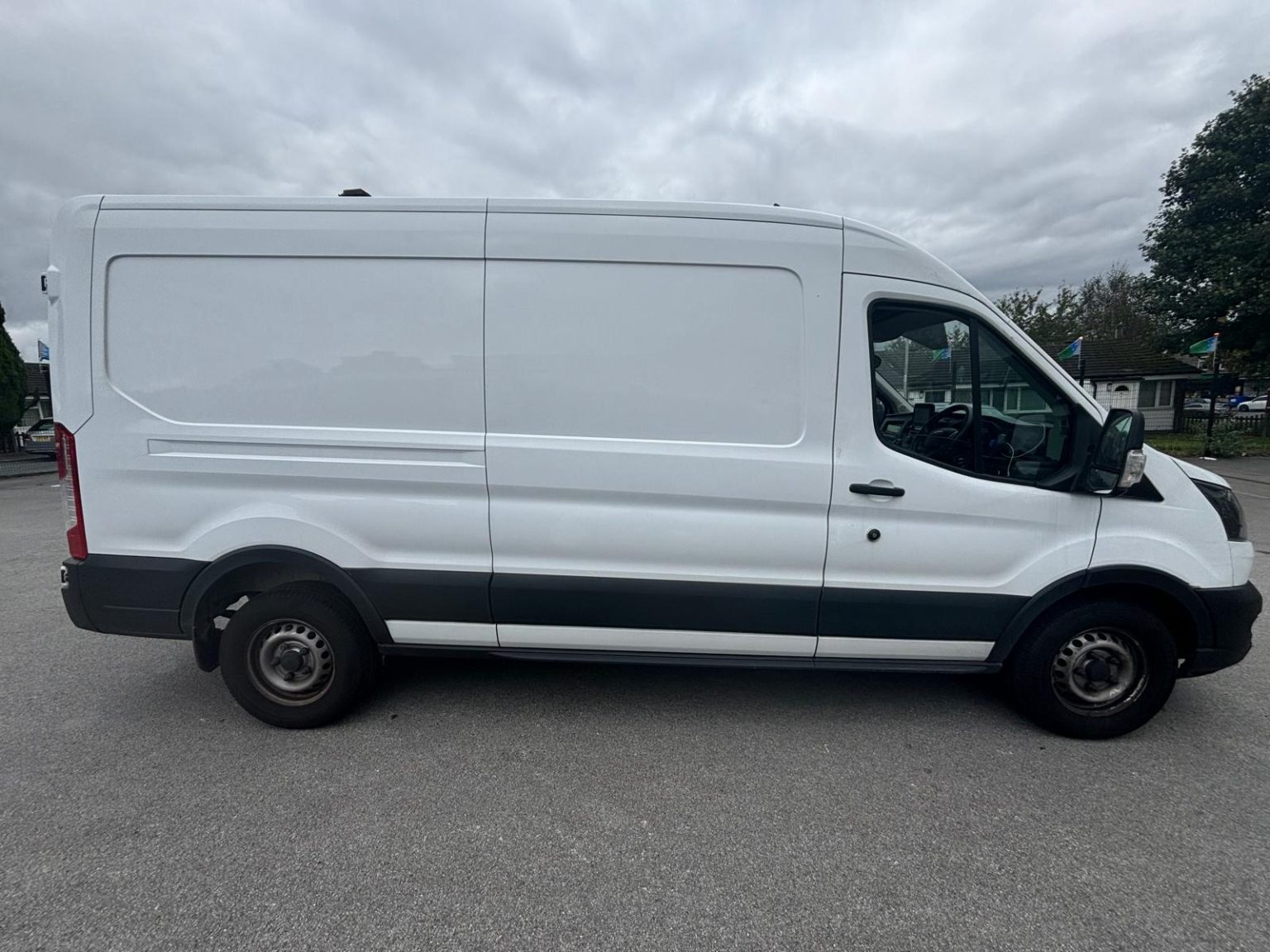
Man With Van Long Wheelbase runs one Ford Transit LWB with the H2 medium roof, driven by one person from Bradford. Measured with a tape inside the load space, rather than taken from the brochure, it gives:
- 3.4m of usable floor length, against Ford's 3,533mm maximum.
- 1.3m between the wheel arches, against Ford's 1,392mm.
- 1.7m of standing height, against Ford's 1,786mm to 1,886mm.
- About 11 cubic metres in all.
- About 2.4m to 2.5m tall overall, so it does not fit under a typical 2.1m car-park barrier. Loading happens on the street, on a drive or in a bay with no height limit.
The measured figures are rounded down and come in a little under Ford's, because brochure maxima run to the bare panels at the widest points. Treat any van's brochure figure as the most it could possibly be, and the measured one as what you can plan around. The van has no tail-lift, so heavy items are planned at the quote from photos, weight, steps and floors.
Reading your own furniture against 3.4m x 1.3m x 1.7m
Each of the three numbers answers a different question about an item. For item-by-item answers on sofas, mattresses, wardrobes and whole homes, see will it fit in a long wheelbase van.
| Measurement | The question it answers | If your item is bigger |
|---|---|---|
| 3.4m floor length | Can it lie flat, front to back, with the doors shut? | It rides at an angle or the van needs a different plan; items over about 3.3m are rare in homes. |
| 1.3m between the arches | Can it sit flat on the floor between the wheel boxes? | It stands on its edge, or sits flat above arch height on top of other things. |
| 1.7m inside height | Can it travel standing up? | It lies down, or, for beds and existing flat-pack, it is taken apart and rebuilt. |
| Rear doors, 1,565mm wide (Ford) | Will it go through the back of the van at all? | It needs to pass the opening one way round, so check both its width and its depth. |
| About 11 cubic metres | Will everything go in one trip? | A second trip, or for a big house, a larger vehicle. |
A fixed price is agreed before setting off, from photos and both postcodes, so send the awkward pieces with their measurements when you ask for a price. Loading, unloading and dismantling of beds and existing flat-pack are included. For whole-home moves, see house removals in Bradford.
Frequently asked questions
What does LWB mean on a van?
LWB stands for long wheelbase: the longer chassis of a van model, with more distance between the axles and a longer load floor. On a Ford Transit the LWB is the L3, with a 3,533mm floor and a 3,750mm wheelbase; on the Transit Custom it is the L2, with a 3,002mm floor.
What are the inside dimensions of a Ford Transit LWB?
Ford gives the L3H2 a 3,533mm load floor, 1,784mm of width at most and 1,392mm between the wheel arches, with 1,886mm floor to roof on front-wheel drive or 1,786mm on rear drive. Load volume is 11.5 or 11.0 cubic metres. The H3 version is 2,125mm or 2,025mm tall inside.
How tall is a Ford Transit van overall?
With the H2 roof, Ford lists 2,411mm to 2,533mm depending on length, drive and load; with the H3 roof, 2,650mm to 2,778mm. Neither gets under a 2.1m car-park barrier. The Transit Custom is about 1.97m.
Is a Transit Custom a long wheelbase van?
Only the L2 version. Ford sells the Custom as an L1 SWB with a 2,602mm floor and an L2 LWB with a 3,002mm floor, both 1,392mm between the arches and about 1.43m tall inside. Even the LWB Custom is shorter inside than a medium-wheelbase Transit.
What is the difference between L3H2 and L3H3?
Only the roof. Both have the same 3,533mm floor and 3,750mm wheelbase. The H3 adds about 24cm of inside height, taking front-drive versions from 1,886mm to 2,125mm, and volume from 11.5 to 13.0 cubic metres, but it is also about 24cm taller outside.
How much weight can a Transit LWB carry?
A 3.5-tonne Transit 350 L3H2 carries roughly 1.0 to 1.4 tonnes, depending on drive, engine and trim, less the driver and passengers. For household furniture, the space usually runs out before the weight does.
Last checked 21 November 2026.